

Handover is the bit of the job where everything you know about a patient has to get into somebody else's head, usually in about a minute and normally with a distraction going on. Things can easily get missed or overlooked if not presented appropriately.
The NHS Institute for Innovation and Improvement describes poor spoken and written communication as the most common root cause of serious errors, and says teams communicate better when they share a standard structure. A handover mnemonic is that structure. In UK pre-hospital and urgent care you'll hear three a lot: SBAR, ATMIST and ASHICE. From those three there is even more that local services or groups have: IMIST AMBO, ATMISTER, CHATS and many more.
SBAR
SBAR
Situation, Background, Assessment, Recommendation
- S Situation: who you are, who the patient is and why you're calling.
- B Background: the clinical context that matters for this problem.
- A Assessment: what you think the problem is, and what you found that tells you so.
- R Recommendation: what you want to happen, and by when.
Best for: Referrals and escalation: ringing an out-of-hours doctor or another service, or handing over between clinicians, when you need the other person to do something.
The NHS Safer Care guide calls SBAR a structured way to pass on information that needs a response, and lists escalation and handover as the main uses, by phone or in writing. It even works for emails.
SBAR's R is the useful bit. The guide talks about getting rid of "hinting and hoping", where you describe the problem and wait for the other person to guess what you want. It also includes a read-back step, where the person receiving the message repeats the key points so you both know it landed.
Here's what a referral sounds like when calling the out-of-hours service: "Hi, it's Sam, a paramedic, I'm phoning about a 78-year-old woman at home. She's had three days of a productive cough and today she's short of breath walking to the toilet. She has COPD, lives alone and hasn't had any antibiotics. She has crackles at the right base and her sats are 94% on air. The rest of her observations are in normal ranges. I think it's a chest infection and I'm worried it's getting worse. I'd like a clinician to see her today, or your advice on whether she needs to come in."
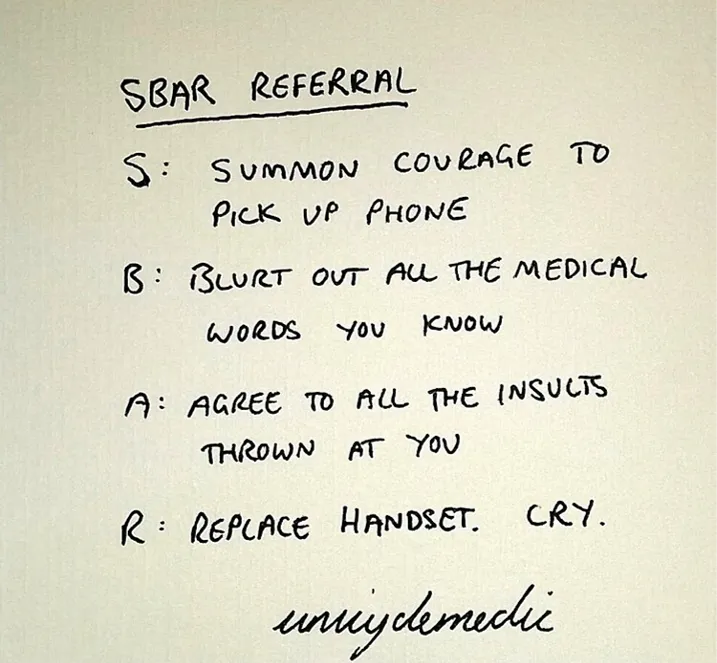
Not every SBAR goes that smoothly. Anyone who has made a referral call will recognise this handwritten version, signed "unwiydemedic":
ATMIST
ATMIST
Age, Time, Mechanism, Injuries, Signs, Treatment
- A Age: the patient's age and sex.
- T Time: time of injury or onset, or of the 999 call.
- M Mechanism: what happened, or the medical problem.
- I Injuries: injuries found, or information related to the medical problem.
- S Signs: signs and symptoms, including observations.
- T Treatment: what you've done so far.
Best for: A short, structured pre-alert or handover to a receiving hospital, for trauma or medical patients.
The joint RCEM and AACE pre-alert guideline from July 2025 says pre-alert calls should be made using ATMIST. For the ambulance folk, your ETA can be tagged on at the start or end alongside callsign. Then comes the ATMIST message, all in around 60 seconds. Its worked examples include one trauma patient and one medical patient. RCEM Learning also calls ATMIST the standard pre-alert tool in the UK.
ASHICE
ASHICE
Age, Sex, History, Injuries/Illness, Condition, ETA
- A Age: the patient's age.
- S Sex: as recorded.
- H History: what led to this, and relevant background.
- I Injuries or illness: what you've found or suspect.
- C Condition: current clinical state, such as observations.
- E ETA: expected time of arrival OR everything else.
Best for: A pre-alert or handover where you want the history and the arrival time up front.
RCEM Learning lists ASHICE next to ATMIST as a common handover structure.
How are they different?
This is where we start talking about clinician preference. Personally ATMIST is for my trauma handovers & alerts, ASHICE for medical at hospital and then SBAR for everything else. SBAR gives you a lot more wiggle room for adding more information depending on the patient.
Which one should I use?
Whichever your service has told you to, and or personal preference. Since the RCEM and AACE guideline (July 2025, due for review in July 2027), that means ATMIST for pre-alerts. The 2020 version left it to each service and gave ATMIST and SBAR as examples. Outside a pre-alert, when you're referring a patient or escalating a concern, SBAR is the one to reach for.
A review of UK ambulance pre-alert guidance found noticeable differences between services in which conditions they treat as suitable for a pre-alert. So check your own trust's current policy, and JRCALC where it applies, before you rely on a mnemonic from a website. That includes this one.
Using them in SnapMedic
The SnapMedic app has a Handover screen with a tab each for ATMIST, ASHICE and SBAR. It lays the prompts out in order, so you can get your head straight before you pick up the radio or phone.
- Each letter gets its own box, with the prompt showing as placeholder text.
- Your entries are saved automatically, and each format keeps its own, so switching tabs doesn't wipe the others.
- Copy grabs the format you're on, ready to paste. Send to My Notes keeps a copy in your notes.
- Clear all empties all three formats for the next patient, after a confirmation.
The Intervention Log can also generate ATMIST, ASHICE or SBAR summaries from what you've logged, so you aren't trying to rebuild the whole job from memory at the end of it. Both are below, the Handover screen on the left and the Intervention Log summary on the right.
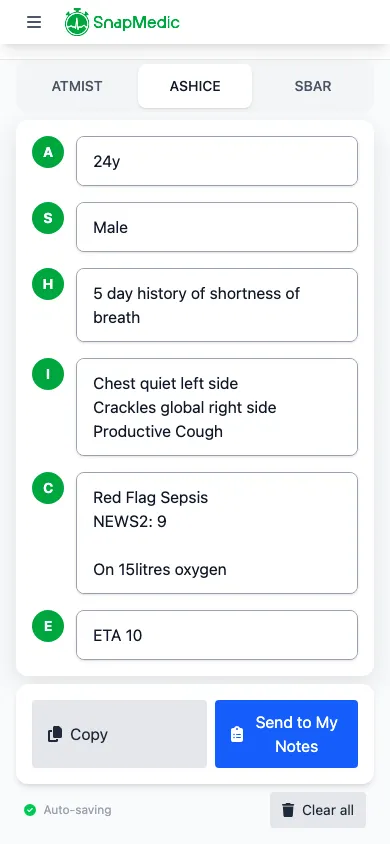
The SnapMedic Handover screen with the ASHICE tab filled in
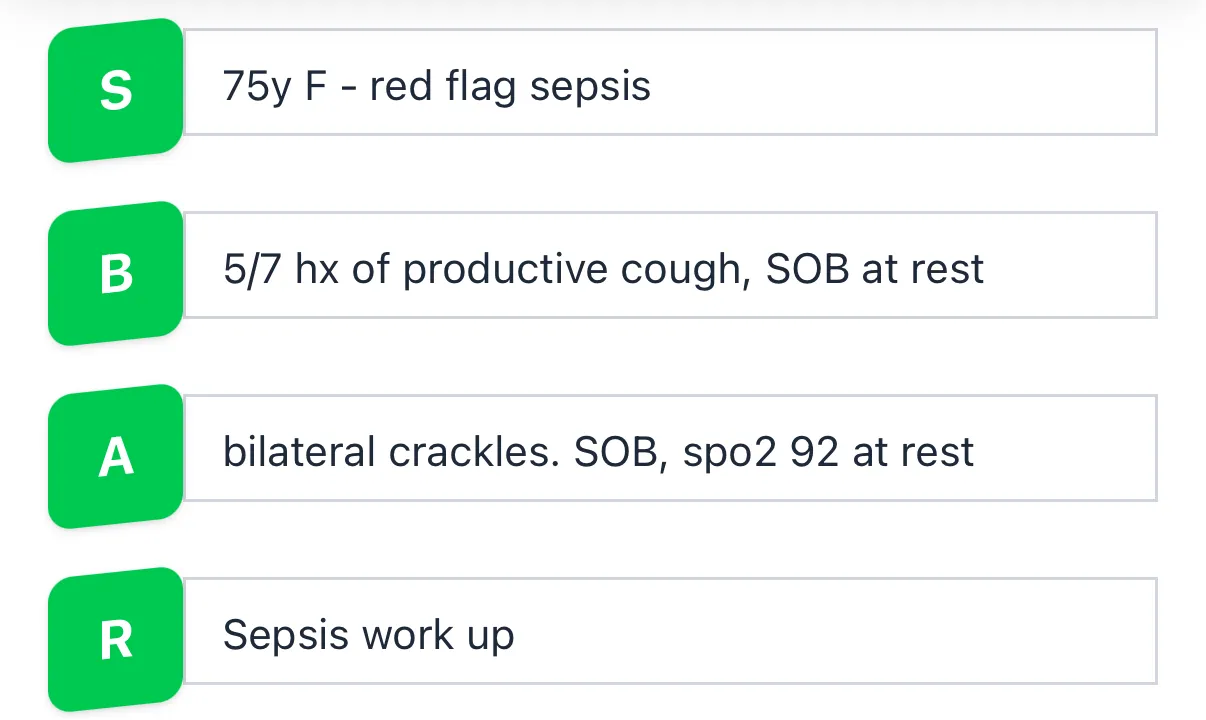
An SBAR handover summary generated from the SnapMedic Intervention Log
If you quote a NEWS2 score in Assessment or Condition, work it out with the NEWS2 calculator. Our NEWS2 guide explains how the score works.
The app lays it out. What you say is still your call.
Making your own handover card
If your team wants its own card, start from the standard prompts above. RCEM Learning suggests asking your receiving hospital which structure they use and whether it gives them what they need, and building a local tool if it doesn't.
Keep it to one page, in one agreed order. Add what your pre-alert needs, such as call sign, ETA and special requirements. Agree it with the hospitals as well as your own crews.
If you need handover recorded on the patient record, have a look at SnapMedic Enterprise and ePCR. The receiving clinician's signature goes on the record, and the receiving team can download it with a case reference and PIN.
Sources
- NHS Institute for Innovation and Improvement, SBAR Implementation and Training Guide (NHS England Improvement Hub).
- RCEM Learning, Pre-Alert (Handover skills module).
- RCEM and AACE, UK NHS Ambulance Services and Emergency Department pre-alert guideline (July 2025), also listed by AACE.
- Boyd A, Sampson FC, Bell F, et al., How consistent are pre-alert guidelines? A review of UK ambulance service guidelines, British Paramedic Journal, 2024.
Try the Handover tool in SnapMedic
Download SnapMedic, open the Handover screen and pick ATMIST, ASHICE or SBAR.
Or try the web version
Free to download • All core features included • Works offline