If your service treats people at events, the rules on CQC registration have changed. Below are the dates, who is affected, and the patient records we would sort out before applying. This isn't legal advice. Check your own position against CQC's guidance.
What has changed
CQC says providers of health care or treatment at an event must register if their service meets the criteria for the regulated activity "Treatment of disease, disorder or injury" (TDDI). It has published guidance for providers of health care and treatment at events that explains which activities that covers.
Hempsons, a law firm that advises health providers, reports that the earlier exemption for treatment at sports grounds and at temporary sporting or cultural events has been removed (Hempsons summary).
The dates
- 7 September 2026: providers can apply to register.
- 1 March 2027: apply by this date and CQC aims to decide before 6 December 2027. Later applications may not be decided in time.
- 6 December 2027: operating without registration becomes an offence. This is also when CQC's monitoring, assessment, inspection and enforcement powers under the new requirements begin.
CQC calls the period up to 1 March 2027 the first stage. If you might be in scope, apply early.
Who is in scope
The test is the activity, not the type of event. Hempsons reports that CQC asks three things: does the service treat disease, disorder or injury, does a listed healthcare professional provide or supervise it, and does it go beyond urgent care or first aid. Hempsons lists independent ambulance services and treatment beyond first aid as examples. That includes monitoring, diagnostics, assessment and triage, and giving medicines.
First aid itself is outside scope. Hempsons quotes the definition as an initial response to sudden illness or injury, to relieve it or stop it getting worse until professional medical help arrives. If your crews only give first aid, you may not need to register. If some go further, read CQC's guidance and decide which side of the line you sit on. If you can't tell, ask CQC.
What CQC is worried about
According to Hempsons, the change follows the Manchester Arena Inquiry and a CQC report on independent ambulance services. It lists variable quality and safety, weak governance and oversight, and gaps in DBS and DVLA checks.
Registered providers must keep accurate, complete and contemporaneous records for each patient. That is Regulation 17 (Good governance) of the Health and Social Care Act 2008 (Regulated Activities) Regulations 2014, paragraph 17(2)(c). Read the regulation on the CQC site and hold your own records up against it.
A records checklist
CQC didn't write this list. It's what we'd want to be able to show an inspector, a commissioner or an event organiser who asks how you oversee care.
- One record for every patient, every time. Paper forms go missing and get filled in unevenly, so check that you can find a record for everyone you saw at every event.
- A clear author for each entry. Say who recorded what and when, including when two crew members worked on one patient.
- A fixed point where a record is finished. Know when it is locked, and keep the original intact if something is added later.
- Written reasons for gaps. If a record is closed with fields missing, say why.
- Medicines recorded against your formulary: quantity, unit, route, and signatures where your policy needs them.
- A review routine. Decide who reviews records and how often, and where you write down what they found.
- Controlled access and retention. Know who can open patient records, how long you keep them and how you export them.
- Handover evidence. Record who the patient went to, and what was said.
Where an ePCR helps
An electronic patient care record doesn't register you with CQC and doesn't make you compliant. What it can do is help you evidence the habits above, because the structure sits in the record itself.
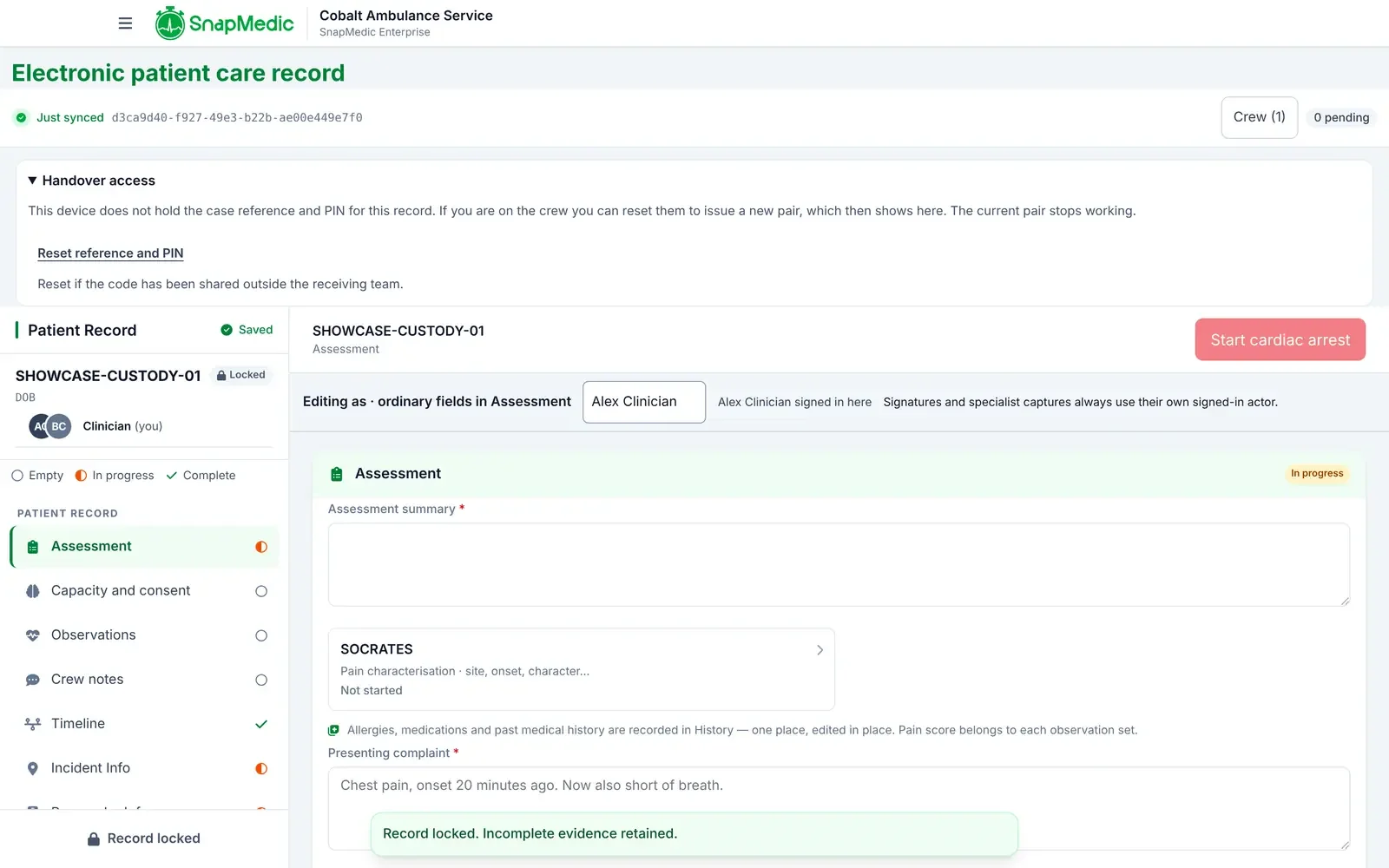
In SnapMedic ePCR, a clinician records care offline, and changes send when signal returns. Each entry keeps its author and time. A colleague joins the same record by exact incident reference, so one patient doesn't end up with two records. Before locking, clinicians see any missing required fields and write a reason to finish with gaps. A locked record is read-only, and anything received afterwards appears as a late entry. Medicines are recorded against your formulary, and the record shows a handover reference and PIN for the receiving team. Access runs through named permissions, with audit logging and encryption.
You build your own forms in the Console, including your required fields, so the record matches the questions you expect to be asked. Treatment decisions stay with the clinician. ePCR has no dose calculator and doesn't make clinical decisions.
For supplier due diligence: SnapMedic Ltd (company number 17449168) is Cyber Essentials certified and registered with the ICO (ZC257109). Patient data is hosted in the UK, in our hosting provider Civo's London region. Those facts help your checks. They don't replace them.
What we'd do first
If we ran an event medical service today, we'd do two things before touching software. Collect every form your crews currently use, and decide who owns record review. Both are free, and both are things CQC is likely to ask about. Then read CQC's guidance and work out whether you're in scope.
To see how this works for your crews, read about SnapMedic ePCR, or tell us about your service and bring your current form.