The Objective Structured Clinical Examination — the OSCE — is the assessment that keeps student paramedics awake at night. Written exams test what you know. OSCEs test what you can do, under pressure, with someone watching and scoring every move. There's nowhere to hide.
The good news? OSCEs are not a test of who's the most naturally talented clinician. They're a test of preparation, structure, and practice. Students who prepare systematically pass. Students who wing it, regardless of how good they are on placement, often don't.
Here's what actually works.
What Examiners Are Looking For
Before you can pass an OSCE, you need to understand what's being assessed. It's not just about getting the right diagnosis. Examiners are scoring you across several domains:
- Systematic approach: Do you follow a logical, structured assessment? ABCDE is your foundation. Skipping steps or jumping to conclusions is the fastest way to lose marks
- Communication: Are you talking to the patient? Introducing yourself, explaining what you're doing, checking consent, asking about pain? Communication marks are among the easiest to earn and the most commonly thrown away
- Patient safety: Do you check for danger? Do you consider allergies before giving drugs? Do you recognise red flags? Safety thinking should be woven through everything you do
- Clinical reasoning: Can you gather findings, form a differential, and justify your treatment decisions? You don't need to name a rare diagnosis — you need to show your thinking
- Documentation and handover: Can you summarise what you've found and what you've done in a structured handover? SBAR or ATMIST — pick the format your university uses and practise it until it's automatic
The Most Common OSCE Mistakes
These are the things that catch students out, year after year:
Skipping steps under pressure. You know you should check the airway before moving to breathing. But in the stress of a timed scenario, students jump straight to what they think the problem is. The examiner can only mark what they see you do.
Not communicating findings aloud. You've checked the radial pulse and noticed it's fast. But if you don't say "radial pulse present, rate approximately 120, regular" out loud, the examiner may not know you've assessed it. Verbalise everything.
Poor time management. Most OSCE stations are 8-15 minutes. That feels like plenty until you're in one. If you spend six minutes taking a history, you won't have time for a proper assessment and treatment plan. Practise with a timer.
Failing to consider differentials. If the patient has chest pain, don't tunnel-vision on MI. Acknowledge that you're considering other causes — PE, pneumothorax, musculoskeletal — even if your working diagnosis is cardiac. It shows clinical reasoning.
Forgetting the basics. Hand hygiene, PPE, scene safety, introducing yourself. These are marks sitting on the table. Pick them up.
How to Structure Your OSCE Approach
Every scenario is different, but the skeleton is the same. Build this framework into your muscle memory:
- Scene safety and PPE — Is the scene safe? Do you need gloves, eye protection? Say it out loud
- Introduction and consent — "Hello, my name is name, I'm a student paramedic. Can I help you today?"
- Primary survey (ABCDE) — Work through each element systematically. Treat life threats as you find them
- Focused history — Use a structured approach. SAMPLE history or similar. Ask about the presenting complaint, past medical history, medications, allergies
- Secondary assessment — Targeted physical examination based on your findings
- Treatment and interventions — Explain what you're doing and why
- Reassessment — Has the treatment worked? Repeat relevant observations
- Handover — Structured summary using ATMIST or SBAR. Practise delivering this in under 60 seconds
This isn't just a passing strategy. It's how you'll work as a qualified paramedic. The OSCE is testing whether you've internalised the process.
Why AI Practice Works for OSCE Prep
Traditional OSCE practice requires a partner willing to play the patient, a quiet room, and ideally someone experienced enough to give useful feedback. That combination is hard to arrange consistently, especially close to exam time when everyone is scrambling for practice slots.
This is where AI practice changes the game.
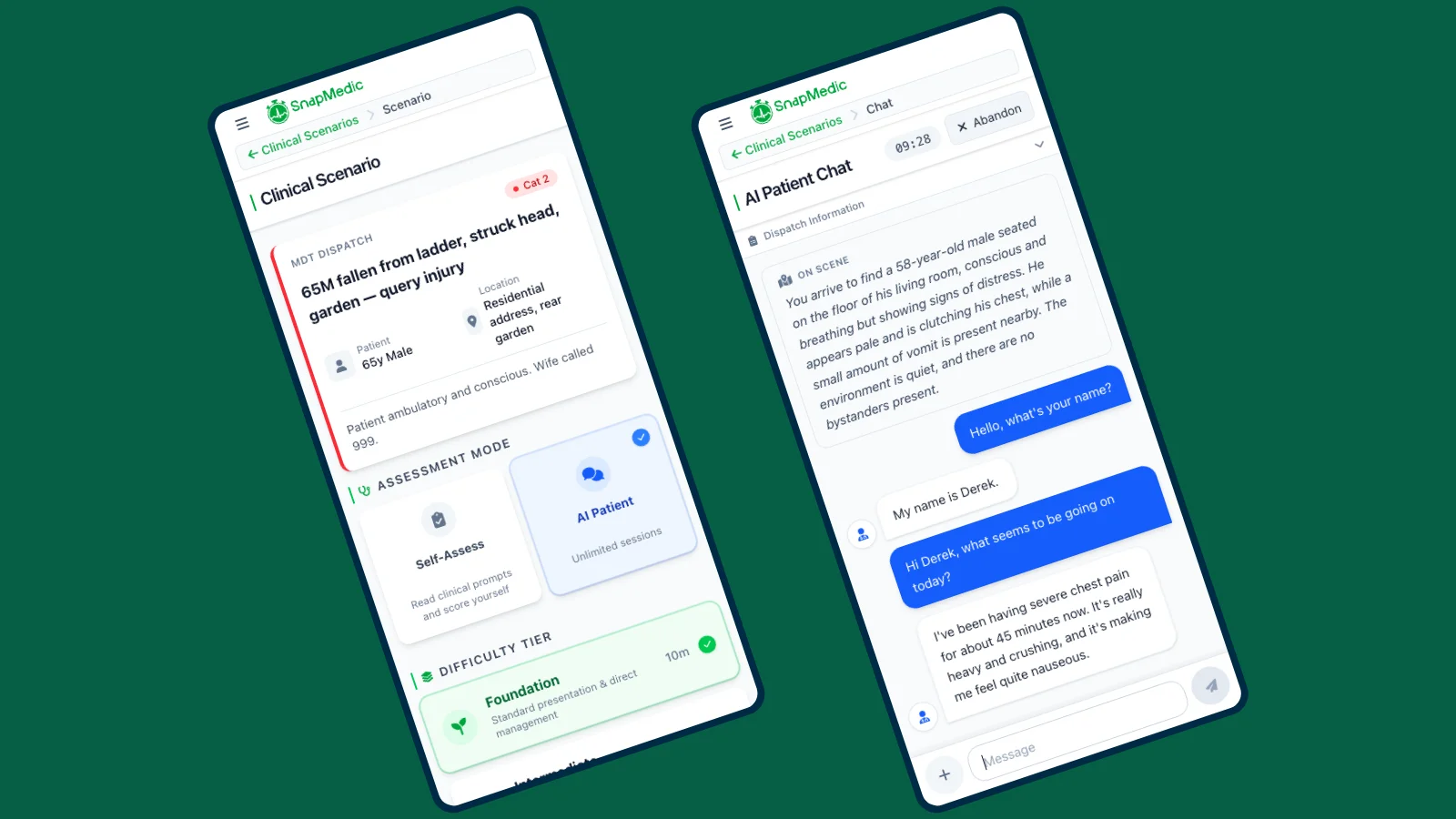
SnapMedic's AI OSCE feature gives you a virtual patient that responds to your clinical questions and assessments in real time. You work through a scenario just as you would in a real OSCE — taking a history, performing assessments, making decisions — and the AI responds naturally based on the clinical scenario.
What makes it effective:
- Available any time. No need to coordinate schedules. Practise at midnight if that's when you're free
- Unlimited repetition. Run the same type of scenario ten times until your approach is automatic. Then move on
- Different scenarios. Foundation, intermediate, and advanced levels across a range of presentations. You're not just memorising one script
- Immediate feedback. The AI gives you clinical feedback on your approach, highlighting what you covered well and what you missed
It doesn't replace practising with real people. Nothing replaces the experience of physically assessing a human being. But for drilling your systematic approach, building confidence in history-taking, and getting comfortable with the flow of a scenario, AI practice is the most efficient preparation tool available.
Practical Tips for the Week Before Your OSCE
Run through one to two scenarios daily. Use AI OSCE practice or partner practice. Focus on variety — don't just do chest pain five times. Cover respiratory, trauma, neurological, and medical presentations.
Identify your weak areas and target them. If you always forget to check blood glucose in altered consciousness scenarios, drill that specific type until it's automatic.
Time yourself. Set a timer for the actual station length. Get comfortable with the pace. If you consistently run out of time, you're spending too long on one section — usually the history.
Practise verbalising everything. Alone, with a mirror, into a voice recorder on your phone. It feels awkward. It works. The goal is that talking through your findings becomes natural, not forced.
Review your university's marking criteria. Every university has a slightly different mark scheme. Know exactly what they're scoring. If communication is worth 20% of the marks, spend 20% of your prep time on communication skills.
The Day Before
Stop revising new material. You're not going to learn a new drug dose in the last 24 hours and reliably recall it under pressure. Instead:
- Run through one or two familiar scenarios at a comfortable pace, just to keep the flow fresh
- Lay out everything you need for the exam — ID, stethoscope, pen torch, whatever your university requires
- Eat well, hydrate, and get to bed at a reasonable time. Sleep matters more than one more hour of cramming
You've done the work. Trust the structure you've built.
You've Got This
OSCEs reward preparation, not talent. If you've practised systematically, built a reliable framework, and drilled your approach across a range of scenarios, you'll walk into that station knowing exactly what to do.
Start your OSCE prep now with SnapMedic's AI OSCE Practice — it's free, and it's built for exactly this.
Download SnapMedic
AI-powered OSCE practice and clinical tools — built for UK paramedics
Or try the web version
Free to download • All core features included • Works offline