Volunteer responder and community first responder groups often run on a small budget and a shared phone. They still need a decent record of what happened with each patient. Here is what we'd look for in an electronic patient care record (ePCR), and how SnapMedic ePCR fits.
What a volunteer group needs
Most groups we talk to want the same handful of things. It has to work with no signal, because responders attend rural addresses, village halls and fields. Two responders need to share one record, since one person often arrives first and a colleague joins later. It has to be simple to run, because there is no IT department and someone gives up their evenings to look after it. The price has to fit donations, a parish council or a charity grant. And patient information has to be held safely, because a small group is just as responsible for it as a large one.
Recording with no signal
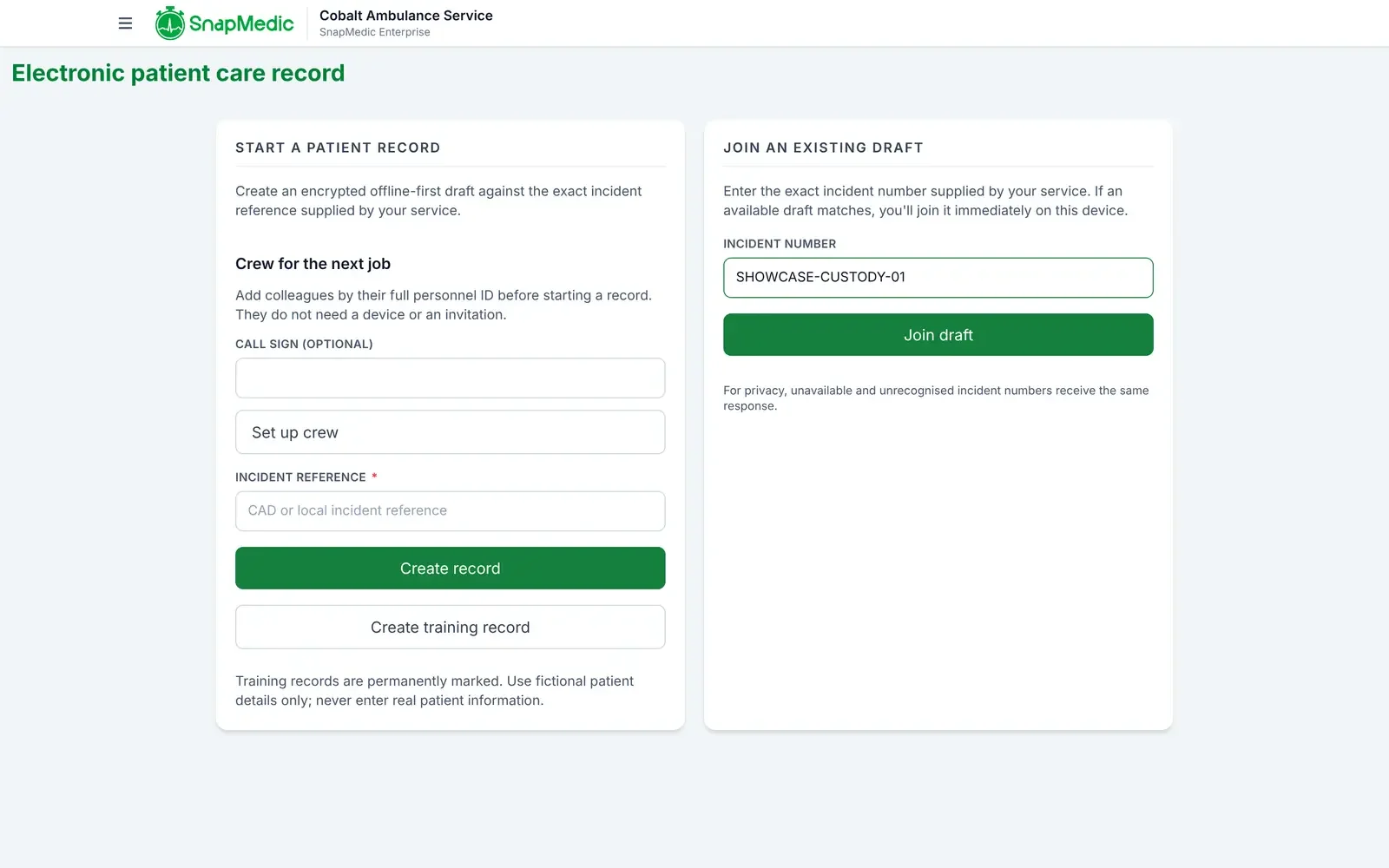
A responder can start a record against an incident or local job reference without a connection. They enter history, observations, interventions and notes as they go. The entries save on the device and send when signal returns, and the app shows how many changes are waiting.
If the patient's name isn't known, the responder records why. Each patient at an incident gets their own record, so a call with two patients doesn't turn into one muddled form.
One record across responders
A second responder doesn't start a second form. They find the draft using the exact incident reference or record ID, and see which incident it belongs to before joining the clinical record. Both can then add to it. Each entry carries its author and time, and if two people edit the same field, the earlier value stays in the history.
While both devices are online, changes show up on the other responder's device within seconds. When care passes to another responder or an ambulance crew, the next person can see what was entered and by whom.
At the end of the call, one clinician locks the record. They see any missing required fields first and write a reason to finish with gaps. The record then shows a handover reference and a 6-digit PIN. The receiving hospital or team enters them on our cases portal and downloads the record without needing an account.
Keeping administration light
An administrator invites members, sets roles and permissions, and revokes device sessions in SnapMedic Console. Members sign in with a one-time email code and an authenticator. There is no public sign-up.
Your administrator builds the form in the Console, starting from a SnapMedic template, and a second person approves it before it goes live. We help with the first one. Your administrator doesn't need technical skills. They need to be someone who can work from your current paperwork and decide who gets access.
Cost
Here is the pricing: £150 a month for up to 50 people, with ePCR included. From 51 to 150 people it's £3 per person per month. Larger organisations get volume pricing from £1 per person.
So a group of 30 pays £150 a month, the same as a group of 50. For a worked example across sizes, see what an ePCR costs for a small provider. Billing for ePCR begins at the agreed live-service date, and we put software, hosting and support in a written quote.
Data and governance
Patient records belong to your organisation. They are stored server-side and readable by the service for authorised synchronisation, audit and support. Access is controlled with organisation isolation, named permissions, encryption and audit logging.
SnapMedic Ltd is Cyber Essentials certified and registered with the ICO. Patient data is hosted in the UK, in our hosting provider Civo's London region, and we keep encrypted backups separately with OVHcloud, also in London. We cover the detail in our security status note. Hosting and retention arrangements are agreed with your group.
Good records can help you show a commissioner, an ambulance trust or a funder how you handle patient information. They don't make you compliant on their own.
ePCR has no dose calculator or dosing decision support. Clinical decisions stay with the responder and your clinical lead.
What we'd do first
Don't start with software. Photograph your current report form and write down the equipment and medicines your responders carry. That one hour of work makes any conversation with a supplier faster, ours included.
Then read about SnapMedic ePCR and tell us about your group. We'll work from what your responders use today.